Heretics

If you were to look at the religion shelf on my bookshelf, it would become clear pretty quickly that I’m interested in church history.  There is something about seeing how things work out just right in history that is cool to me.  One major set of topics that shows up in church history is the various heresies that pop up periodically.  While studying this topic is nice because by learning what the church says is wrong you also learn what is right, today I want to focus on heretics themselves.  Specifically, I want to talk about how heretics are presented in games and what a heretic is (and isn’t) in real life.

The term heretic is actually pretty common in various games and fictional settings.  In pretty much any setting with a religion (especially an fanatical one), characters that come into conflict with the religion tend to be branded heretics.  For example, I’ve been recently playing Final Fantasy Tactics.  About half way into the game, the main character Razma ends up fighting Cardinal Draclau who has taken the princess hostage. 
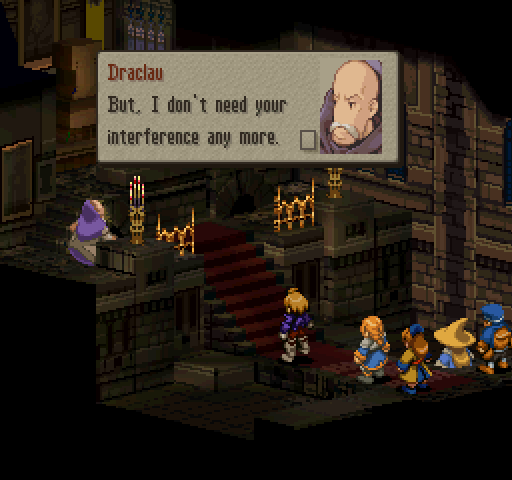
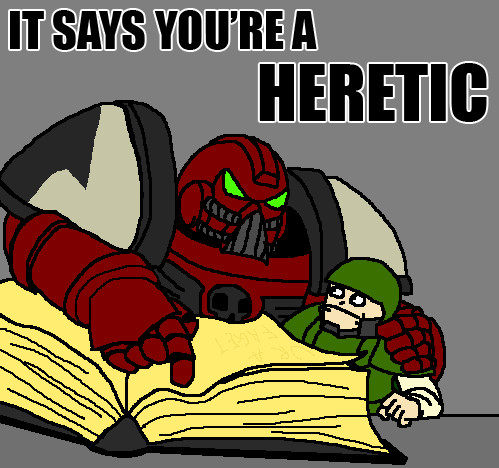
The cardinal uses magic to turn into a monster, but Razma and his team defeat him.  As a result, the church declares him a heretic and the people of the world are told to capture or kill him on sight, despite the fact that the cardinal was the one in the wrong.  This kind of setup is common, and is often used with the “church is secretly evil” plot twist to make the player character enemies of the world.  Another minor example from a more recent game is Fire Emblem:  Three Houses.  Early in the game, some members of the western branch of the Church of Seiros plot to rebel against and attack Archbishop Rhea.  As a result, they are branded heretics and you the player have to fight them, eventually leading to their execution.  In probably the most extreme example, there is the world of Warhammer 40000, where anything going even slightly against the Empire of Man can be considered heresy.  It’s so over the top in this setting that in extreme cases it is justification for wiping out an entire planet.  It’s so extreme that Warhammer heresy memes and jokes are pretty common online.
Even looking at The Legend of Heroes series, heretic is used to denote enemies of the church, although in that case, it is limited to rebellious and out of control clergy.  So as you can see, most fantasy settings with a church will simply use the term heretic to refer to an enemy of the church.  But what exactly is a heretic in real life?

Simply put, a heretic is someone who has an incorrect belief, is told that belief is incorrect and to stop believing it by some kind of authority, and choosing to believe it anyways (I believe the term “obstinately” shows up in the official definition).  The important parts of this definition are the second and third parts, namely that a heretic has been corrected by some authority and still deliberately chooses to be wrong anyways.  This is important because it means that someone who is wrong about something isn’t a heretic, just someone who is wrong.  For example, the church father Origen had many beliefs that the church today would consider wrong, but we wouldn’t call him a heretic because no one corrected him at the time (as the doctrines in question weren’t fully developed).  On this flip side, Arius would be considered a heretic, because even after the Council of Nicea said his beliefs about Jesus were wrong, he still continued to preach it.  This also explains why the church would consider the original Protestants heretics but not modern ones.  The early Protestants were under the authority of the church who told them they were wrong but chose to ignore that.  Modern Protestants however were raised outside the church and thus lack that authority correcting them.  The next question would be once someone is a heretic, what should be done about them?  In most fictional settings, the answer is almost exclusively to execute them.  In real life, execution was indeed an option, but typically only after spending considerable time convincing the person to give up their incorrect opinion.  The justification for executing them would typically be to prevent the incorrect belief from spreading and leading more people away from the church and to give them a clear period of time to help them repent (similar to the Catholic justification for the death penalty).  This is the justification used (whether right or wrong) to execute Jan Hus, one of the proto-Protestants.  So overall, heretics are people who are wrong, told they are wrong by a church authority and choose to remain wrong rather than simply any enemy of the church.  And while they have been executed in the past, it is typically as a last resort, not an automatic response.

So as you can see, heretics in fictional religions don’t really align with the real thing.  As I mentioned earlier, I believe the reason the term heretic is thrown around in games so often is that it is an easy way to get the world to turn on the player even if they are the hero, especially in conjunction with the church is secretly evil trope.  I’ll admit, while I’m completely sick of the church being secretly evil, I tend to be more ok with the main characters being branded heretics because it tends to lead to interesting gameplay (as being on the run usually limits your options).  I just hope people understand that fictional stories don’t necessarily correspond to reality.

Song of the Post

Apoplexy

Final Fantasy Tactics

For some reason the best songs in Final Fantasy Tactics are named after medical terms

The Legend of Heroes

As I’ve mentioned in the past, usually the religions in video games inspired by Catholicism only resemble it superficially, copying the look and feel of the religion without any of the actual content that matters.  I honestly didn’t think I’d ever find anything better than a superficial but positive portrayal, but that changed last year when I started playing through the Legend of Heroes series. This JRPG series started in 2004 and is ongoing to this day.  The two main selling points of the series is the large, interconnected story in all the games of the series (the main plot is supposedly only 60% done) and the great world building enabled by NPC dialog that is constantly updated as you progress regardless of if it relevant to what you are doing.  Like most fantasy games it includes a fictional religion resembling Catholicism- the Septian Church. Unlike most games, however, it goes much deeper than a superficial resemblance. I wanted to spend some time talking about the Septian Church in this game and its similarities and differences to Catholicism.

To start off, I want to talk about the similarities between the Septian Church and Catholicism.  The world in the game is kind of loosely inspired by Europe in the mid 1800s, but with monsters and some new technology that is making things advance quickly to the present’s level of tech.  The various countries in the game are clearly inspired by those of the time, for example, Erebonia is basically Imperial Germany, Calvard is basically the French Republic and Liberl is basically Switzerland.  One country mentioned but not focused on in the game is Arteria- a city that is the center of the church (clearly a reference to the Vatican). Each city in the game has a church that resembles a Catholic church in terms of architecture as expected with an assigned priest (or bishop in the big cities) that runs it.  

A lot of the terms used by the church associated characters are Catholic instead of simply generic religious terms common in most games.  For example instead of “going to church” there is “going to Mass” and there are references to groups like the “Congregation for the Sacraments” back in Arteria.  The churches even have “Sunday School” where they teach the kids both religion and general knowledge in lieu of a modern school system. While all this would make it resemble the Catholic Church more than most games, it would still be superficial.  What really sells it for me is the dialog of the church affiliated characters. As I mentioned before, one of the big selling points of this series is that the NPC dialog is constantly updating as you play, often unrelated to the plot. As I was playing the game, the dialog of the church affiliated characters impressed me with just how Catholic it sounded.  One incident in particular that stood out to me in Trails in the Sky SC. Relatively late in the game, a town is attacked by the villains and the market that is the center of the town is completely destroyed- leaving the townspeople distraught and unsure of what to do. If you take a detour during this event and go talk to the town’s priest he’ll talk to you about suffering and the power of redemptive suffering.  I remember at the time thinking that the dialog sounded straight out of a Catholic homily on suffering. This kind of dialog is found all throughout the series and really makes the Catholic connections obvious.

While the Septian Church is clearly Catholic inspired, it’s still in a fictional world so there are some differences.  Probably the biggest is the Gralsritter- the church’s secret special ops team protecting the world behind the scenes. Because there are dangerous magical relics from the beginning of the world (for example, an item that stops time for everyone but its user or an item that turns whatever it touches into salt), the church established the Gralsritter to retrieve these relics and store them safely away where they can’t be used for evil.  Obviously since there isn’t anything similar to those relics in Catholicism, there is no need in the real world for such an organization. On top of that, at least one member of the Gralsritter is basically an assassin. While some of the people he kills in the game could arguably fall under the Catholic Church’s teaching on the death penalty, I can think of at least one that wouldn’t. Beyond the Gralsritter there are other small differences.  One is that the church is much less hard on animism- the game’s equivalent to paganism. People in the world are welcome to worship the wind for example, as long as they also worship the goddess of the Septian Church. This is in contrast to Catholicism, which clearly states that it is wrong to worship anything other than God (it doesn’t get more direct that the first commandment). Another small difference is the role of nuns in the church. In the Septian Church, the role of nuns is similar to that of permanent deacons- they kind of help out the priest in charge of the church, whereas in Catholicism nuns are parts of religious orders rather than directly tied to a local parish.  From what I understand, this difference comes from a cultural difference between Japan and the west. For whatever reason nuns are associated with old Shinto shrine maidens so even if a character is supposed to be more of a Catholic nun, their role will be more along that of the shrine maiden (while I’m not a huge fan of the site, TV Tropes does have an article explaining this common difference pretty well- https://tvtropes.org/pmwiki/pmwiki.php/Main/NunsAreMikos).  So while the Septian Church is significantly more Catholic than most fictional game religions, differences do exist.

Overall, I was extremely impressed with how religion was portrayed in the Legend of Heroes series and how close it was to real Catholicism.  It’s honestly really refreshing to see a church portrayed in such a positive light and relatively accurately in contrast to the negative, superficial portrayal much more common in games.  When I first played the games, I honestly thought these associations were made by some Catholic localizer in order to give some added realism to the church’s dialog, but it turns out I was wrong.  In an interview with the president of Falcom (the creators of the series), he revealed that the Septian Church was created to be a Japanese view of the Catholic Church- something mysterious and exotic but overall trying to do good in the world.  After reading that interview, I have to say they absolutely succeeded. While the series isn’t complete yet so there is still a chance for things to go south in the future, for now I extremely like what was done with religion in The Legend of Heroes.

Song of the Post-

Aster House

Trails in the Sky the 3rd

This was the most Catholic sounding song in the series I could think of